Showing posts with label Course Readings Entry. Show all posts

Thursday, October 8, 2009

Chinese Islamic Arts and Style

was pleasantly surprised to see that one of the readings from this week revolved around Chinese Islamic Calligraphy - as if my fascination with it wasn't evident enough already.

It's actually the idea of how some degree of artistic flair makes its way into religion that really strikes me as pretty amazing.  Not just with writing in the calligraphic form, but also architecture - most notably with the design and beautification of Chinese mosques.  Like calligraphy, the architecture style lying behind the mosques is a perfect example of the melding together of two different cultures, incorporated into one being.  Chinese mosques and 'traditional' Arabian-styled mosques are very distinct from each other and easy to tell apart.  The background cultural influence of the area's culture is evident from the style that it is built upon


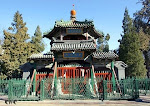
The mosque, upon first glance looks very 'Chinese' - that is, it is able to easily blend itself with the surrounding environment among the distinctly Chinese-styled buildings.  And yet it's a brilliant example of the coming together of different cultural influences to create a a meeting point between two very different worlds.


Compare the above mosque with the more 'common' Arabian-styled mosques and the overt influence of Chinese culture can be easily seen.  I think it's great to see the acculturation of different cultures blending in together to create something new.  Additionally, it'd make it much easier for Muslim societies in China to blend in with the rest of society - especially since they would be considered a minority group against the majority Han-Chinese people.

The same thing can be said about calligraphy.  This may not be completely correct, but I like to think that there is some degree of 'commonality' between Arabic scripts and Chinese scripts, mainly in the manner by which it is written.  Both Arabic and Chinese characters appear to me as more artistic words, rather than plain written texts.  The English alphabet on its own looks rather simple and straight forward, whereas I like to see Chinese and Arabic written texts as something far more appealing to the eyes.

Going back to the idea of mosques and the architecture, Chinese mosques are, like traditional Arabian-styled mosques, have their interior and exteriors decorated with calligraphic pieces of work.


Again, the influences of both cultures can be seen coming together to create a single, united piece of writing.  Clearly Chinese by the manner and materials used to write it, yet with that noticeable blend of Arabian calligraphy worked into it.

Wednesday, September 30, 2009

A diverse culture of the Hui kind

Michael Dillon's sections are focused in particular on the Hui community within China - their history, particularly significant events dating back to early dynasty of which the results are still being played out even today, culture and overall development of the identity that the members of this society carry on so dearly.

Of particular interest, to me, was the idea of how the Hui are managing themselves and their culture within the greater Han Chinese society that they co-exist with - whether it's in a peaceful manner or in an ethically tense manner. Regardless of the the manner of these two communities' co-existence with each other, I think it's the idea of assimilation that comes off as important here.

No matter how much resistance that is given, I would say that it is inevitable for religions, cultures, and ethnic identities to find itself assimilating, to some degree, with the surrounding, usually majority-based, cultural society around it. For the Hui Chinese, that would inevitably be the Han Chinese - generally regarded as the 'typical' example of what Chinese culture is seen as. 

I wouldn't say that I see this assimilation or acculturation on a one-sided basis. That is, it isn't just the Hui culture that is being assimilated with the Han Chinese culture - the reverse is also applicable and true, to whatever degree it may be. Culture and religions are always developing because of this; their encounters and exposures to something new inevitably leads to the birth of a somewhat 'new' form of the former. In other words, Hui Chinese culture finds itself taking in aspects of Han Chinese culture and incorporating it into whatever was already in existence. Generally the change is most likely not that great, but still - there is a new 'form' that is birthed. This combination of different cultures and identities, at some points aiding in the formation of new ones, is an interesting phenomeno.

Wednesday, September 16, 2009

A History of Ethnic Clashes

It's always fascinated me how over a billion people live in a single large country like China. Even more fascinating is the existence of dozens upon dozens of varying ethnic groups and cultures within this bordered off land. Their interactions with each other, be it co-existence or conflict, and the history behind these trends is also quite interesting to read up on. I think it'd be fair to argue that the situation with the ethnic Uighur group in China and their conflict with the Han Chinese has received considerably more worldwide media attention in our post-9/11 world than it was in our pre 9/11 times. I would say this is because our post-9/11 world has, understandably, developed a greater interest in all things 'Islamic'.

The ethnic tensions, according to Perdue and Millward, has been there for a number of centuries, since the time Islam found its way to the region via Arabian and Persian merchants. While Muslims can be found in various regions around the country, it is the minority majority Uighur group in the Xinjiang province that has been under considerable focus. Ethnic tensions between the Uighur and Han-Chinese dates back for many centuries, with the Uighur constantly striving for independence. Unsurprisingly, such tensions have only degraded into violence over and over again - we've seen riots this past summer and, more recently, the rising spat of attacks by hypodermic needle-wielding citizens in the city of Urumqi. It's obvious enough that Human Rights activists and the Uighur themselves would love nothing more than to gain their independence, but given the long drawn out history that surrounds this ethnic group and their relation with the Han-Chinese, I highly doubt that we'll be seeing any sort of progress any time soon. Certainly not on their own, at least.

The Xinjiang region has been a volatile one, undergoing political and social tensions. On their own, the Uighur don't stand a chance, at least under more violent or aggressive methods. Given that we're in a post-9/11 world where violence + Islam has, in general, drawn an immediate association with militant terrorism, it's understandable that most would be reluctant to side with the Uighur, or find it easy to condone any violent acts of resistance. Not only that, China's position as a growing world power would make any country who could have any sort of influence (such as the US) reluctant to take any sort of action....of course, there's also the fact that taking any sort of action would probably give them no direct benefit to begin with anyway.

In either case, it'll be interesting to see how the current situation plays out, most especially in the politically explosive age that we're currently living through.